Monday, October 14, 2013

Jack/Sam Hall

Today's song is Jack Hall, an 18th-century English ballad about a bitterly unrepentant criminal collected in the Roud Folk Song Index. The song, also known is Sam Hall, is based on a real-life figure. Jack Hall was sold as a climbing boy to a chimney sweep for a single guinea. The unfortunate youth became an infamous thief and highwayman. He was arrested in 1707, along with Stephen Bunce and Dick Low for the burglary of the house of Captain Guyon near Stephney. All three were convicted and hanged at Tyburn on December 7th, 1707. The song was known as Jack Hall primarily up until the 1850s, when the English comic minstrel CW Ross popularized the song as Sam Hall. The song has been locally adapted in Ireland and the United States. Folk music historians have noted similarities between this piece and the song Captain Kidd.

The following video shows the Dubliners with their rendition of Sam Hall, which adapts the song to Ireland by changing the place of the hanging to Cootehill, in County Cavan.


Steeleye Span has recorded a folk-rock version of the song under the original name Jack Hall, found here.


The song's lyrics are as follows. Note that in the original, the name was "Jack Hall", and the hanging place was Tyburn Hill, rather than Cootehill.

Oh my name it is Sam Hall chimney sweep, chimney sweep
Oh my name it is Sam Hall chimney sweep
Oh my name it is Sam Hall and I've robbed both great and small
And my neck will pay for all when I die, when I die
And my neck will pay for all when I die

I have twenty pounds in store, that's not all, that's not all
I have twenty pounds in store, that's not all
I have twenty pounds in store and I'll rob for twenty more
For the rich must help the poor, so must I, so must I
For the rich must help the poor, so must I

Oh they took me to Cootehill in a cart, in a cart
Oh they took me to Cootehill in a cart
Oh they took me to Cootehill where I stopped to make my will
Saying the best of friends must part, so must I, so must I
Saying the best of friends must part, so must I

Up the ladder I did grope, that's no joke, that's no joke
Up the ladder I did grope, that's no joke
Up the ladder I did grope and the hangman pulled the rope
And ne'er a word I spoke, tumbling down, tumbling down
And ne'er a word I spoke tumbling down

Oh my name it is Sam Hall chimney sweep, chimney sweep
Oh my name it is Sam Hall chimney sweep
Oh my name it is Sam Hall and I've robbed both great and small
And my neck will pay for all when I die, when I die
And my neck will pay for all when I die

Tyburn hill, where the real Jack Hall was hanged, is a small village now engulfed in present-day London, named for the Tyburn stream, which is now paved over. The village was the central site of capital punishment in England for centuries, being the place where the Crown executed many criminals, traitors, and religious dissidents up until 1783.

Executions began there as early as 1196, when populist leader William 'the Bearded' Fitz Osborn was hanged there. William Osborn was a fiery preacher who roused the poor of London in a movement against the city's rich, gathering weapons throughout the city and amassing a large following. The Archbishop of Canterbury, Hubert Walter, fearing an insurrection, sent men to arrest William. The preacher fled into the nearby church of Saint Mary le Bow, attempting to use it not as a sanctuary, but as a fortress. The church was a poor choice, as most of William's followers refused to defend it by force, and the building was set on fire by the Archbishop's men, who wounded William in the stomach as he emerged from the burning structure. William was convicted, dragged naked by horse to Tyburn, and hanged.

A hanging at the Tyburn Tree
Tyburn continued to be used as an execution site for the better part of the millennium. The leaders of the Catholic/Populist Pilgrimage of Grace uprising were hanged there in 1537, among many other Catholic martyrs over the years. Also notable was the hanging of Oliver Cromwell, John Bradshaw, and Henry Ireton, who were dug up from the grave and hanged as punishment for their roles in beheading King Charles I. By 1571, the site was so frequently used that a special gibbet known as the Tyburn Tree was built there to enable mass executions (in some cases, as many as twenty-four people hanged simultaneously). The Tyburn Tree stood in the middle of the road way, providing a landmark on the way to London, a warning to criminals, and a steady source of cadavers for anatomists. Executions at Tyburn proved a public spectacle, bringing crowds numbering in the thousands. Such a spectacle would have been the last sight of the historic Jack Hall.

The song has been adapted in American form. In this version, Sam Hall is no longer a burglar, but a convicted murderer. The song comes across as less wistful than the English version, and more spiteful. There is no mention of 'the rich must help the poor' or any other attempt to endear Sam Hall as a Robin Hood like figure or social bandit. Any endearment that the Sam Hall in the American version gets comes only from his abrasive, defiant attitude to death. The song can be found here, arranged by Johnny Cash.


The lyrics to this version are as follows. Note that in some versions, the singer says, "damn your hide", instead of "damn your eyes". Other variations include replacing "and I hate you one and all" with "and you're a bunch of fuckers all" or other insults. 

Well, my name it is Sam Hall, Sam Hall.
Yes, my name it is Sam Hall; it is Sam Hall.
My name it is Sam Hall an' I hate you, one and all.
An' I hate you, one and all:
Damn your eyes.

I killed a man, they said; so they said.
I killed a man, they said an' I smashed in his head.
An' I left him layin' dead,
Damn his eyes.

But a-swingin', I must go; I must go.
A-swingin', I must go; I must go.
A-swingin', I must go while you critters down below,
Yell up: "Sam, I told you so."
Well, damn your eyes!

I saw Molly in the crowd; in the crowd.
I saw Molly in the crowd an' I hollered, right out loud:
"Hey there Molly, ain't you proud?
"Damn your eyes."

Then the Sherriff, he came to; he came to.
Ah, yeah, the Sherriff, he came to; he came to.
The Sherriff, he come to an he said: "Sam, how are you?"
An I said: "Well, Sherriff, how are you,
"Damn your eyes."

My name is Samuel, Samuel.
My name is Samuel, an' I'll see you all in hell.
An' I'll see you all in hell,
Damn your eyes. 

The song is also known in the US Air Force as the hilariously uncouth marching song "Sammy Small". Lyrics and a beautifully rendered recording can be found here. In addition to this rendition, there is a Vietnam War version of Sammy Small which has decidedly anti-war lyrics.

Sunday, October 13, 2013

On the Scene: Dunn Brothers on Grand Open Mic (10/13/2013)

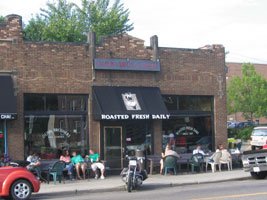
The original Dunn Brother's, at 1569 Grand Ave
Welcome back, readers! Today is the first installment of a series I'll be doing for the blog, titled "On the Scene", where I review and talk about bands, shows, artists, and open mics I've been lucky (or unlucky) enough to see. For today's inaugural On the Scene post, I went down to the Dunn Brothers on Grand open mic, held every second and fourth Sunday of the month. It was a tough choice to make- the Twin Cities has a huge range of open mics, and Sunday is a popular date. Of the ones I know of today, there was Columbia Grounds at 10:30, Kieran's at noon, the workshop at Keegan's at four and their Irish Sesiun at 6, Coffee Shop NE at 7, and Dunn Brother's on Grand at 7:30. I was tempted by all of them, but my sister and new brother-in-law had been asking when I would play at Dunn Brother's since before I moved down, so I called them up and asked them to meet me there.

I have to say, I think I made the right choice. The open mic night at DBoG, hosted by Gary Lumpkin, seems to be one of the better-organized and higher-quality ones in the city. The joint was buzzing when I got in and only got more packed as the show approached- the audience filing through the door punctuated here and there by a guitar case marking a musician. By the time the show began, there were barely enough seats- and in typical Minnesotan style, a good many people standing, too polite to take the last chair.

Some of the open mics I've been to down here have been sloppy and poorly organized, but not this one. The sign-up sheet filled out and expanded fast, and a three-song limit per performer was evenly enforced. Amps and mics were provided with excellent sound mixing and, with the exception of a handful of particularly breathy singers, the volume level was ideal throughout the night. Most importantly, the performers themselves were consistently of a high quality. One or two may have been a bit flat or sloppy, but there was nobody that had to be genuinely suffered through, as is sometimes the case at open mics. There was a decent variety, ranging from spoken word to Bosnian folk songs, though most acts stuck to acoustic contemporary and American singer-songwriters. A folk purist in the crowd tonight would have risked some disappointment at the lack of more traditional music, but variety is the spice of life and folkies can't dominate every open mic.

An artist looking to perform to the largest audience possible tonight would have been well-served to come early and sign up for one of the first time slots. I went fifth, and the audience had begun to thin out by the time I played. By the ninth or tenth artist, hardly a dozen people remained. Those who stayed, however, were well served. You never know when you'll find a gem in an open mic night- and tonight, one of the last performers stole the show.

I first noticed this teenage guitar-slinger when he came in, carrying a case plastered in political stickers- a clear and open Democrat. Before I knew anything else about him, I looked forward to his set, expecting a set full  of protest songs. When his turn came around, he didn't play anything political- but I wasn't the least bit disappointed. Instead, I got something much better than I'd hoped for.

He introduced himself as Nate D'Angelo, from Martha's Vinyard, Massachussetts. From his first song, 'My Autobiography', I could tell he was a caliber above the typical open mic crowd. He held himself with a confidence that belied his youth, and laid out solid, highly proficient guitar with a clear, strong, and emotive voice. His vocal control was great- however he warbled, I don't think he fell flat once during the night. What really impressed me, though, was his songwriting. He played three originals, and each one was record-worthy material. He had the sort of creativity that crafts turns of phrases at once both original and intuitively familiar. He wove those together to create the kind of narratives that take a personal, individual story and seemlessly reflect through it on larger feelings and ideas, without having to shoe-horn anything in. It was truly a pleasure to hear him.

About halfway through the second song, I turned to my sister, and said, "He's only 15, and playing like this? He's going to be a professional for sure". Little did I know, he already is! I was able to get a business card from the bulletin board, and find his album on his bandcamp site. I've listened to it, and prefer him live, but the album's nothing to pass up.

I wish I could say more on the night and the last performers, but we headed out shortly after Nate got done with his set. One thing's for certain, though- if they were anything like the other performers, they were probably worth staying for, and if the Dunn Brother's open mic night is this good every time, I'm going to make it a regular commitment.

Friday, October 11, 2013

Down by the Sally Gardens And Related Songs

Today's song is Down by the Sally Gardens, an adaptation of a poem by WB Yeats, not to be confused with the reel titled "Sally Gardens". The word 'salley' is lesser known English variation of the word 'sallow', meaning 'willow'. It is similar to the Irish word 'saileach', Old English 'sealh' and the Latin 'salix', all also meaning 'willow'.

I have chosen the gorgeous arrangement sung by Maura O'Connell with Karen Matheson, seen on the BBC/RTE co-production, TransAtlantic Sessions.


The lyrics, as written by WB Yeats, are as as follows:
Down by the salley gardens my love and I did meet;
She passed the salley gardens with little snow-white feet.
She bid me take love easy, as the leaves grow on the tree;
But I, being young and foolish, with her would not agree.
In a field by the river my love and I did stand,
And on my leaning shoulder she laid her snow-white hand.
She bid me take life easy, as the grass grows on the weirs;
But I was young and foolish, and now am full of tears.
The poem was originally published in 'The Wandering of Oisin and Other Poems' as 'An Old Sung Resung' According to Yeats, it was "an attempt to reconstruct an old song from three lines imperfectly remembered by an old peasant woman in the village of Ballisodare, Sligo, who often sings them to herself." The identity of this song is uncertain, but it is likely to have been "The Rambling Boys of Pleasure". This song can be found here, arranged by Andy Irvine.


The lyrics of the song are as follows:

You rambling boys of pleasure, give ear to those few lines I write,
Although I'm a rover, and in roving I take great delight.
I set my mind on a handsome girl who ofttimes did me slight,
But my mind was never easy till my darling were in my sight.

It was down by Sally's Garden one evening late I took my way.
'Twas there I spied this pretty little girl, and those words to me sure she did say
She advised me to take love easy, as the leaves grew on the tree.
But I was young and foolish, with my darling could not agree.

The very next time I met my love, sure I thought her heart was mine,
But as the weather changes, my true love she changed her mind.
Cursed gold is the root of evil, oh it shines with a glittering hue,
Causes many the lad and lass to part, let their hearts be ever so true.

Sure I wish I was in Dublin town, and my true love along with me.
With money to support us and keep us in good company.
With lots of liquor plentiful, flowing bowls on every side,
Let fortune never daunt you, my love, we're both young and the world is wide.

But there's one thing more that grieves me sore is to be called a runaway
And to leave the spot I was born in, oh Cupid cannot set me free,
And to leave that darling girl I love, oh alas, what will I do?
Will I become a rover, sleep with the girl I never knew

Yeat's words, based off of You Rambling Boys of Pleasure, were never set to that song's tune. Instead, they have been adapted to various different melodies. These include the Moorlough Shore (also the tune of "The Foggy Dew") in 1909 by Herbert Hughes, an original piece by Rebecca Clarke in the 1920s, a piece by John Ireland in 1934, a vocal setting by Ivor Gurney in 1938, and a setting by Benjamin Britten in 1943. The version by Britten, based on an earlier Irish tune, is the most widely used one in folk music circles today, and the one that Maura O'Connell sings above.

Also, of interest is an American song with a similar tune and name, called "Down in a Willow Garden", also known as "Rose Connelly". It can be found on this video, performed by the Kossoy Sisters.


Interestingly, this version of the song radically departs from  takes the form of a murder ballad, with the following lyrics

Down in the willow garden

Where me and my love did meet

there we sat a-courtin'

My love dropped off to sleep
I had a bottle of Burgunday wine
which my true love did not know
and there I poisoned that dear little girl
down under the banks below

I stabbed her with my dagger
which was a bloody knife
I threw her into the river
which was a dreadful sight
my father often told me
that money would set me free
if I would murder that dear little girl
whose name was Rose Connelly

and now he sits by his old cottage door
wiping his tear-dimmed eyes
and now he waits for his own dear son
upon the scaffold high
my race is run beneath the sun
though Hell's now waiting for me
for I did murder that dear little girl
whose name was Rose Connelly

This song likely originated in Ireland before coming to America. A song called "Rose Connelly" is mentioned by folk music collector Edward Bunting in Coleraine near Derry in 1811, and a version of the song was documented in Galway in 1923. In America, the song was originally restricted to Appalachia, leading later folk music historian DK Wigley to conjecture that "It is as if an Irish local song never popularized on broadsides was spread by a single Irish peddler on his travels through Appalachia." The song was first documented in America in 1895 in Wetzel County, West Virginia.  Cecil Sharpe documented the song's existence in North Carolina and Virginia in 1918. Though a wide variety of verses have historically existed, the song has become solidified to a standard several verses through recording and popularization. The first professional recording was done in 1927 by GB Grayson and , and the song became more widely known following Charlie Monroe's recording in 1947.

It is likely that the lyrics of "Down by the Willow Gardens" are related to the Irish song Wexford Girl,  also known as Oxford Girl or The Bloody Miller, which also gave rise to the American song Knoxville Girl. Wexford Girl is itself likely derived from the old English song, The Cruel Miller. It has been noted that part of the melody is only similar to Down in Sally Gardens, but is also the melody to Rosin the Beau. These several songs, however, will be the subjects of a future posts.

Thursday, October 10, 2013

Jute Mill Song

Today's song is The Jute Mill Song, a Scottish piece from the Industrial Revolution, written by the socialist agitator Mary Brookbank. Brookbank, a communist activist, was a jute mill worker herself. At the time she wrote the song, Dundee was the jute capital of Europe- indeed, of the world.

Women and girls working at a Dundee Jute Mill
The first jute mill was built in Dundee around the 1830s when it was discovered that whale oil from the city's whaling industry could be used to make the spinning of the Indian fiber possible. Employing rural migrants, the Jute Barons made Scotland the gateway to the European jute market during the 19th and early 20th centuries, with over 130 mills employing 40.3% of Dundee's workers in 1911- 75% of those workers being women, many of them married. Brookbank described the experiences of these women in writing as well as song. To quote,

"The life of the women workers of Dundee right up to the thirties was ... a living hell of hard work and poverty. It was a common sight to see women, after a long ten-hour-day in the mill, running to the stream wash-houses with the family washing. They worked up to the last few days before having their bairns. Often they would call in at the calenders from their work and carry home bundles of sacks to sew. These were paid for at the rate of 5 pence for 25, 6 pence for a coarser type of sack. Infant and maternal mortality in Dundee was the highest in the country."

Women working in a Bangladesh jute mill
The days of Dundee as the center of the world's jute industry were not to last forever. The conquest of South Asia during the 19th century allowed the investors to move operations to the cheaper labor of colonial Bangladesh, and by 1914 these investments had paid off in cheap imported jute, leading to the industry's decline from Dundee after the First World War. Dundee fell into economic depression until new industries located there after World War Two. India, Pakistan, and Bangladesh continue to lead the world in jute exports today.


I've chosen two versions of the song to represent the song. Karan Casey's arrangement is finely sung, with instrumentation, though it is somewhat faster than the typical arrangement. 

The lyrics of the song are as follows:

O, dear me, the mill is running fast
And we poor shifters canna get nae rest
Shifting bobbins coarse and fine
They fairly make you work for your ten and nine

O, dear me, I wish this day were done
Running up and doon the Pass is nae fun
Shiftin', piecin', spinning warp, weft and twine
To feed and clothe ma bairnie offa ten and nine

O, dear me, the world is ill-divided
Them that works the hardest are the least provided
But I maun bide contented, dark days or fine
There's no much pleasure living offa ten and nine

 I've also included Tony Archibald's version, which is closer to the tempo the song is typically sung at. Another great example is Frances Carlin's recording, as well as Ewan McLennan's. 


I recently made my own recording of the song. This version is in English, rather than Scots, and played in standard tuning on Capo 3 and played on the C, F and G7 chords, fingerpicking in the middle four strings (which, of course, makes the G7 interchangeable with a G, the high E not being played).

One of the aspects of this song that I enjoy is that, while it is a clearly political song written by a political author for political purposes, the lyrics do not explicitly become social criticism until the last verse. Instead, it lays out in plain terms the experiences, feelings, and frustrations of the mill worker. Instead of starting from a grand and abstract view of the whole of society, it starts from a humanizing, personal perspective, and builds from there. This is a very powerful technique in writing political songs, as seen in such examples as Plane Wreck at Los Gatos, the Ballad of Joe McDonnel, or Paradise. The Jute Mill Song is one of the best examples of it- when it does finally reach its political message, it does so only briefly, but plainly. Instead of becoming excessively blatant and pontificating
on its point, the song first invites the listener into empathizing with the mill workers and their experiences, then reaches its broader conclusions as a natural extension of those experiences.

Wednesday, October 9, 2013

High Germany

Hello, and welcome back to Folk Infusion!

Today's song is High Germany, an English folk song about a pair of lovers forced to part by the War of Spanish Succession. I've chosen the Luke Kelly version for this song. While the song is English and Kelly an Irishman, I can't resist Luke Kelly in just about any context.


of course, I am a stickler for accuracy and love a bit of variety,  so I'll include the Englishman Martin Carthy's version as well.


In fact, since I've recorded my own arrangement, I'll include that one, too!

The words and chords of the song are as follows. 

Capo on the 2nd Fret 

  Em             G             Am         Em
“Oh Polly love, oh Polly, the rout has now begun,
    G               C     G       D             Em
And we must go a-marching to the beating of the drum.
   G                  C       G           D           Em
Go dress yourself all in your best and come along with me;
       Em              G    Em     Am       Em
I'll take you to the cruel war in High Germany.”

   Em             G             Am         Em
“Oh Willy love, oh Willy, come list what I do say,
   G          C      G        D           Em
My feet they are so tender, I cannot march away.
  G                      C      G              D    Em
And besides, my dearest Willy, I am with child by thee,
       Em             G   Em     Am       Em
Not fitted for the cruel war in High Germany.”
[ Tab from: http://www.guitaretab.com/t/traditional-irish/257970.html ]
  Em                 G          Am                      Em
“I'll buy for you a horse, my love, and on it you shall ride
  G          C      G        D                Em
And all my delight shall be a-riding by your side.
 G                      C      G             D     Em
We'll stop at every alehouse and drink when we are dry,
     Em           G           Em     Am       Em
We'll be true to one another, get married by and by.”

 Em                 G              Am                 Em
Oh, cursed be them cruel wars that ever they should rise
 G               C        G           D         Em
And out of Merry England press many a man likewise.
 G                         C       G             D     Em
They pressed my true love from me, likewise my brothers three,
    Em               G       Em     Am       Em
And sent them to the cruel wars in High Germany.

 Em                       G           Am            Em
No, my friends I do not value nor my foes I do not fear,
 G               C        G       D        Em
Now my love has left me I wander far and near.
G                       C          G       D     Em
And when my baby it is born and a-smiling on my knee
Em                    G    Em      Am   Em
I'll think on lovely Willy in High Germany.

   Em             G             Am         Em
“Oh Polly love, oh Polly, the rout has now begun,
    G               C     G       D             Em
And we must go a-marching to the beating of the drum.
   G                  C       G           D           Em
Go dress yourself all in your best and come along with me;
       Em              G    Em     Am       Em
I'll take you to the cruel war in High Germany.”

The "High Germany" in the song is a bit of an archaic term, which some readers may not recognize. It refers to the mountainous southern part of Germany, descended from the Latin "Germania Superior". In old  German, it was called Hochdeutschland (a name later considered for the name of Austria, when the country became a republic in 1918). The region gives its names to the High German dialects. 

The song, as I mentioned earlier, is set during the War of Spanish Succession, which was fought between blocs of European powers from 1701-1714 over the right to succeed Charles II to the Spanish throne. The frail, mad, and obscenely inbred monarch died at the age of 38, with the autopsy reporting that his body "did not contain a single drop of blood; his heart was the size of a peppercorn; his lungs corroded; his intestines rotten and gangrenous; he had a single testicle, black as coal, and his head was full of water.".

The face of aristocratic incest

With Charles II's  death, the sprawling but militarily declining Spanish empire was set  to unite with the French under the heir apparent, Phillip V, threatening the balance of power in Europe. The rival claimant to the throne was Archduke Charles of Austria. The Two Crowns alliance of France, the pro-Phillip Spanish, and the Electorate of Bavaria fought the Grand Alliance of the Holy Roman Empire, the pro-Charles Spanish, Great Britain, Portugal, the Dutch Republic, and the Duchy of Savoy. The fighting mainly occurred in Europe, but also included Queen Anne's War in North America between the British and allied tribes and the French and allied tribes.

Though the war initially went against the Two Crowns, disagreeable peace terms lead the French to continue fighting, and the forces loyal to Phillip turned the tide against the Grand Alliance forces. Meanwhile, the death of the Austrian Emperor Joseph causing Archduke Charles to become Emperor Charles, threatening the create a union of the Holy Roman Empire and Spain in place of the union of France and Spain if he won. The war ended with the treaty of Utretcht and Rastatt, which recognized Phillip V as the King of Spain, but removed him from succession to the throne of France and so forbid a personal union of the kingdoms.

As a result of concessions in the treaties, the Austrians gained significant grounds in Italy and the Netherlands from the Spanish, and the British were granted Gibraltar and slave-trading rights in Spain's American colonies for three decades. Britain also gained French territory in the Americas, and French hegemony over continental Europe was broken.

The Battle of Blenheim, Bavaria 1704, was a decisive victory for the Grand Alliance

Philip would go on to press the territorial claims of Spain. Shortly after the end of the war, he announced he would claim the French throne to succeed Louis XIV if the infant Louis XV were to die. This, along with his attempts to seize Italian territories, would start the War of the Quadruple Alliance in 1717, a mere three years after the end of the War of Spanish Succession.

As is often the case, this greater political context is not important to the narrative of the song- it is but a backdrop and a setting for the real story, the personal one of two lovers torn apart by the war. The narrator cares not for the machinations of the powerful, save only to curse their wars that press her loved ones from her. The powerful may be forces that shape her world, but they are not the center of it- not even worth mentioning in her song. There's a certain poetry in this. While the kings and lords of Europe battled over lands and crowns, it is not the rights of Phillip V or the glory of Charles of Austria that we sing about. It is William, and Polly.

Tuesday, October 8, 2013

Eamonn an Chnoic

Hello, and welcome to Folk Infusion! I've started this blog as a place to share particularly interesting folk songs, with their historical context and any other commentary that bears inclusion. In the future, this scope may expand to include reviews of folk groups or albums, thoughts on the genre and traditions, and original songs, among other possibilities. Its primary purpose, however, is to simply appreciate folk songs with the care and depth that they deserve.

Today's song is a person favorite of mine-- Eamonn an Chnoic, or "Ned of the Hill". This Irish ballad tells the story of Eamonn O Riain (Edmund or Ned O'Ryan), a Gaelic noble who becomes a ropaire (a political outlaw) after the Cromwellian conquest dispossessed him of his land. 

According to tradition, Eamonn's career as an outlaw occurred not only because of the loss of his family's lands, but also because of his shooting of a tax collector during a brawl. Eamonn was, according to the story, trying to defend an old woman from having her milk cow confiscated. This is among many stories told of Ned that paint him as a Robin Hood like figure.

An image of a ropaire band, from the novel "Willy Reilly"


How Eamonn's family lost their lands is a matter of some contention. Some versions of the story maintain that the lands were confiscated generations before his birth following the Desmond Rebellion. However, the circumstances of the time and the lyrics of the song seem to indicate that Eamonn grew up as a land-owner before losing those lands from the Acts of Settlement in 1652. This penal law imposed sentences including land confiscation and death to the participants of the 1641 Rebellion and subsequent unrest. The 1641 rebellion, which Eamonn evidently took part in, was an attempt by the Catholic members of the gentry of Ireland to seize power from the English colonial administation. 

The conflict was sparked by fears among the Catholics of a Protestant invasion of the island by anti-Catholic forces within England and Scotland that were growing increasingly resistant to the Catholic monarchy of Charles I. The rebellion marked the beginning of the Confederate Wars between the Irish Catholic Confederation and the English and Scots Protestant settlers, and also contributed to the tensions that sparked the English Civil War- both of these wars, among others, being considered part of the larger Wars of the Three Kingdoms. The Irish Catholic Confederacy was able to briefly win control over large parts of the country in a vicious conflict that saw scorched earth tactics and ethnic cleansing used by both sides. 

However, at the conclusion of the First English Civil War, the English Parliament sent reinforcements to Ireland, inflicting crushing defeats on the Confederate forces in a series of particularly brutal battles and massacres. A brief reprieve granted by the Second English Civil War was squandered due to internal conflicts in the Confederacy over the possibility of an alliance with the English royalists. Oliver Cromwell, emerging victorious in England, proceeded to invade Ireland with an exceptionally trained and funded army. The Cromwellian invasion took an immense toll on the Irish people through battles, ethnic cleansing, the famine and outbreak of plague that took place during the conflict, and the penal laws that followed the invasion. 

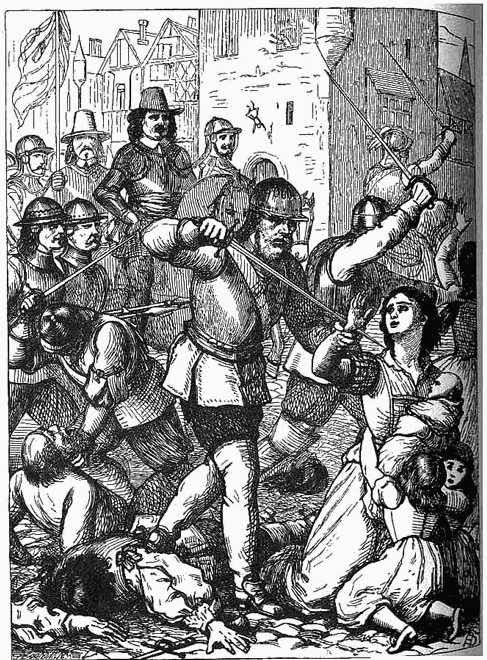
Cromwell's troops take Drogheda


Many defeat rebels and displaced landlords took to guerilla warfare and banditry during and after the Cromwellian invasion. These guerillas were known variously as ceithearnaigh choille ('wood kernes'), toraidhe (pursuer- the origin of the modern term "Tory"), or ropaire ('pike-man'). These bandits fought the English establishment, resulting in harsh counter-guerilla measures by the colonial administration. Eamonn, by all indications of the song and traditions, was one of these ropaire.

While the exact details of Eamonn's life immediately following the War of the Confederacy is mostly a matter of speculation and story, it is known that Eamonn served in the Williamite War of 1689-91. During this time, his name appeared in a pamphlet in which he and four other ropaire leaders call for the Irish to support the Jacobite cause and place the Catholic James II on the throne instead of William of Orange. James II was the heir of his brother Charles II, who had regained his throne following the death of Cromwell. He was deposed when anti-Catholic nobles in his own country invited his protestant son-in-law, William, to seize the throne. James II fled to Ireland, and there raised an army to reclaim his throne. However, these Jacobites were defeated at the Battle of the Boyne and subsequent battles, further cementing the English hold on Ireland.

While no records show what Eamonn did after the war, the words of the song indicate that he fled "eastward across the sea". This presumably refers to continental Europe, possibly as part of the Flight of the Wild Geese with other defeated Jacobites, or independently. Some accounts, however, report that he was murdered for the price on his head.

The original Gaelic version of the song is well-represented by the Wolfe Tones, in this recording: 


The lyrics are as follows

"Cé hé sin amu
a bhfuil faobhar a ghuth,
a’ réabadh mo dhorais dhúnta?"

"Mise Éamonn a' Chnoic,
atá báite fuar fliuch,
ó shíor-shiúl sléibhte is gleannta."


"A lao ghil 's a chuid,
cad a dheánfainn-se dhuit
mura gcuirfinn ort binn de mo ghúna?

'S go mbeidh púdar dubh
'á lámhach linn go tiubh,
‘s go mbeidh muid araon múchta!"


"Is fada mise amu
faoi shneachta is faoi shioc,
‘s gan dánacht agam ar éinne.

Mo bhranar gan cur,
mo sheisreach gan scor,
is gan iad agam ar aon chor!


Níl cara agam—
is danaid liom sin—
a ghlacfadh mé moch ná déanach.

‘S go gcaithfe mé ghoil
thar fairraige soir,
ó's ann nach bhfuil mo ghaolta."


Translated directly, this comes out to: 

"Who's that outside
whose voice is urgent,
pounding on my closed door?"

"I'm Éamonn of the hill,
drowned, cold and wet,
from endlessly traveling mountains and glens."


"Dearest love and treasure,
what can I do for you
but cover you with the lap of my dress?"

And black gunpowder will be
fired endlessly at us,
and we will both perish!"


"I've long been outside
in snow and in frost,
not daring to approach anyone.

My fallow unplanted,
my team in need of unyoking,
and I no longer have them at all!


I have no friend—
how that grieves me—
who’d take me in, early or late.

And so I must go
eastward across the sea,
for it’s there I have no kindred."


The song has been translated into English in two different main translations. One is nearly verbatim to the original's content, which is no small feat in translating a song. That version can be found here, performed by the Dubliners' own Sean Cannon:


Strangely, however, this version of the song is not widely sung. Instead, most performances I have found choose to use an adaptation of the song rather than a translation, with English words that do not attempt to confer the meaning of the Gaelic original, or even the feel. In the adaptation widely sung, the song is not so much a lament of the wandering Ned, as it is a rather fanciful love story of Ned courting a nobleman's daughter.


Though this adaptation has a great deal of merit in its own right, it is in truth simply a different song altogether than Eamonn an Chnoic- the meaning and tone of the original are replaced entirely. I greatly prefer the accurate translation, and find myself distraught that it does not the popularity of this more romanticized adaptation. Because the only recording I can find anywhere is Sean Cannon's version, I took it upon myself to record my own arrangement of the accurate translation.

As a final note on the song, I should include the following version by The Pogues, which is not so much a translation or adaptation as much as a..... reimagining. I once played this at a party, thinking the person requesting "Ned of the Hill" meant this one. From her reaction, I gathered that she was not expecting it!