Happy Monday, readers! In recognition of the work week starting yet again, today's song is a piece from the Industrial Workers of the World. "The Preacher and the Slave", also called "Long-Haired Preachers", was written by union organizer and later martyr Joe Hill in 1911. The song was written during a period of conflict between the anti-capitalist IWW and the Salvation Army, which opposed the union's leftist goals. In some cases, bosses opposed to the IWW's message would even send in Salvation Army bands to drown out agitators and speakers. This song is one of several parodying the Salvation Army's hymns- in this case, the song "In the Sweet By and By", written in 1868 by S. Fillmore Bennett and Joseph P Webster. The following rendition is by Utah Phillips, the late famous folk singer, Wobbly, and co-founder of the Catholic Workers' Joe Hill House of Hospitality in Salt Lake City.
This rendition is by Blake Hutchings, a UK-based singer/songwriter
The lyrics are as follows, with the parts in brackets often shouted by other performers, as seen in this recording of myself and a banjo-picker named Rachel perform it some years ago in St. Cloud.
Verse #1:
 G                          C         G
 Long-haired preachers come out every night
 G                                       D
 Try to tell you what's wrong and what's right
 G                        C            G
 But when asked how 'bout something to eat
 G                   D         G
 They will answer in voices so sweet

 Chorus Type #1:
 G                     C
 You will eat [you will eat!], bye and bye [by and by!]
 G                               D
 In that glorious land above the sky [way up high!]
 G                      C
 Work and pray, live on hay [live on hay!]
 G                     D            G
 You'll get pie in the sky when you die [that's a lie!]

 Verse #2:
 G                  C          G
 And the Starvation Army, they play
 G                                    D
 And they sing and they clap and they pray
 G                      C           G
 Till they get all your coin on the drum
 G                       D             G
 Then they tell you when you're on the bum

 Chorus Type #1

 Verse #3:
 G                C            G
 Holy Rollers and Jumpers come out
 G                                   D
 And they holler, they jump and they shout
 G                  C           G
 Give your money to Jesus, they say
 G                  D        G
 He will cure all diseases today

 Chorus Type #1

 Verse #4:
 G                     C            G
 If you fight hard for children and wife
 G                                 D
 Try to get something good in this life
 G                   C             G
 You're a sinner and bad man, they tell
 G                     D          G
 When you die you will sure go to hell.

 Chorus Type #1

 Verse #5:
 G                 C           G
 Workingmen of all countries, unite
 G                                D
 Side by side we for freedom will fight
 G                      C              G
 When the world and its wealth we have gained
 G                     D           G
 To the grafters we'll sing this refrain

 Chorus Type #2:
 G                     C
 You will eat, bye and bye [bye and bye]
 G                                          D
 When you've learned how to cook and how to fry [how to fry!]
 G                             C
 Chop some wood [chop some wood], 'twill do you good [do you good]
 G                      D             G
 Then you'll eat in the sweet bye and bye [that's no lie!]
Hello, reader(s)! Because the blog missed two weekdays, I thought I'd start to make them up with some extra posts. So, today's folk infusion is "The Deamon Lover", a Scottish folk song known in America as "The House Carpenter" (Roud14, Child 243). The song is also sometimes called "James Harris" or "James Harries".
The song tells the story of a woman whose former lover has come to visit her after being long away at sea. The woman tells this lover that she will not go with him him or marry him, because she now has a husband and children. In some versions, the husband is named as James Harris or his occupation is given as a house carpenter. The lover convinces her to come with him by promising her ships, wealth, and travel. The woman goes along with him, only to fall into mourning as she misses her husband and babe and discovers that her lover was not her lover at all, but the devil come to trick her into damnation. The devil shows her the hills of heaven and the hills of hell, and tells her she is going to hell, then sinks the boat, killing her.
Here is The Deamon Lover performed by Alasdair Roberts.
The lyrics, as arranged in Alasdair Roberts' rendition, are as follows:
Where have you been my long, long love These seven long years or more? I'm seeking for my former vows You gave to me before'
'Oh, hold your tongue of your former vows For they will breed sad strife Hold your tongue of your former vows For I'm become a wife'
He's turned him right and round about And the salt tear blint his ee 'I never would have trodden on Irish ground But for the love of thee'
'If I should leave my dear husband And my two babes also What have you to take me to If I with you would go?'
'I've seven ships upon the sea And the eighth brought me to land With four and twenty mariners bold And music on command'
She's put her foot on board the ship No mariners she beheld But the sails were of the taffeta And the masts of the beaten gold
They had not sailed a league, a league A league but barely three Til dismal grew his countenance And drumly grew the sea
They had not sailed a league, a league A league but barely three Until she saw his cloven foot And she wept most bitterly
'Leave off your weeping' then said he 'Of your weeping let me be And I'll show you how the lilies grow On the banks of Italy'
'What hill, what hill is thon I see As white as any snow?' 'Thon is the hill of heaven' he said Where all good people go
'What hill, what hill is thon I see As black as any coal?' 'Thon is the hill of hell' he said 'Where you and I must go'
He struck the top mast with his hand And the main mast with his knee And he struck that gallant ship in two And he sunk her beneath the sea.
Here is the more lively American adaptation, House Carpenter, performed by American folk master Doc Watson.
Here is another arrangement of House Carpenter, performed in an even more lively rendition by the Irish band Sweeney's Men.
Also worth noting is Bob Dylan's song, the Man in the Long Black Coat, which tells the story from the House Carpenter's perspective. Because Bob Dylan does generally not allow his own recordings to be shared freely on the internet, here is that song covered by Mark Lanegan:
Welcome back to Folk Infusion! Today's song is "John Brown's Body", an old Civil War marching tune, as well as some major anthems that have spring up from the same tune. The song is written in honor of the abolitionist John Brown, most famous for his attacks on members of pro-slavery militias in Kansas, his attempted taking of Harper's Ferry in Virginia, and his subsequent execution.
The tune of the song was taken was from "Say Brothers Will You Meet Us", a simple and repetitive three-verse hymn from the camp meetings of the Second Great Awakening of the 1800s (though some folk music historians claim it goes back further, to an African American wedding song, a British sea shanty, or a Swedish tune). This Second Great Awakening, which began in the 1790s and had passed its peak around the 1840s, was a Protestant revival movement in response to the rise of skepticism, deism, and rationalism. During the Awakening, itinerant preachers would roam the frontier, organizing large meetings where families would travel and camp to listen to preachers and sing hymns. In typical Camp Revival style, "Say Brothers Will You Meet Us" has no set lyrics. Improvisation, driven by religious fervor and passion, was important to revivalist music.While I cannot find a recording of the hymn and have neither the time nor inclination to make one, a person listening at a camp revival may have heard lyrics something like this:
Say, Brother, will you meet us down by Canaan's happy shore? (x3)
as we go marching on
Chorus:
Glory, glory, alleluiah! (x3)
as we go marching on
Say, Sister, will you meet us down by Canaan's happy shore? (x3)
as we go marching on
By the grace of God we'll meet you,...
That will be a happy meeting,.....
Jesus lives and reigns forever,....
his Judgement Day is coming...
It was from this basic mold that John Brown's Body arose. The new lyrics seem to have come,
according to an 1890 account, from a group of soldiers in the
Massachussetts Second Infantry Batallion, or the "Tiger Batallion".
Apparently, these soldiers were not only singing about John Brown the
abolitionist, but also getting some degree of mirth from the fact that a
Sergeant John Brown was enlisted with them. According to the veteran George Kimball's account in 1890,
"We had a jovial Scotchman in the battalion, named John Brown. . . . and
as he happened to bear the identical name of the old hero of Harper's
Ferry, he became at once the butt of his comrades. If he made his
appearance a few minutes late among the working squad, or was a little
tardy in falling into the company line, he was sure to be greeted with
such expressions as "Come, old fellow, you ought to be at it if you are
going to help us free the slaves"; or, "This can't be John Brown--why,
John Brown is dead." And then some wag would add, in a solemn, drawling
tone, as if it were his purpose to give particular emphasis to the fact
that John Brown was really, actually dead: "Yes, yes, poor old John
Brown is dead; his body lies mouldering in the grave."
These phrases eventually became a mantra, according to Kimball's account, until they were adapted into words and put to the tune of the hymn. By May 12, 1861, the song was used as a flag-raising anthem at Fort Warren. On July 18th, Boston newspapers reported the Tiger Battalion singing the song while marching through the city's streets, and a rash of broadsides appeared, spreading the tune.
The song varied, as marching songs are wont to do, from place to place much like the hymn that inspired it. The basic model, however, was:
John Brown's body lies a-mouldering in the grave; (3X)
He's gone to be a soldier in the army of the Lord! (3X)
His soul's marching on!
(Chorus)
John Brown's knapsack is strapped upon his back! (3X)
His soul's marching on!
(Chorus)
His pet lambs will meet him on the way; (3X)
They go marching on!
(Chorus)
They will hang Jeff Davis to a sour apple tree! (3X)
As they march along!
(Chorus)
Now, three rousing cheers for the Union; (3X)
As we are marching on!
From the beginning, the song's somewhat irreverent lyrics caused discomfort to some listeners.
It may have been these concerns that caused William Weston Patton to write and publish his more lyrical version of the song, in December 1861 in the Chicago Tribune. These lyrics are follows:
Old John Brown’s body lies moldering in the grave,
While weep the sons of bondage whom he ventured all to save;
But tho he lost his life while struggling for the slave,
His soul is marching on.
(Chorus)
John Brown was a hero, undaunted, true and brave,
And Kansas knows his valor when he fought her rights to save;
Now, tho the grass grows green above his grave,
His soul is marching on.
(Chorus)
He captured Harper’s Ferry, with his nineteen men so few,
And frightened "Old Virginny" till she trembled thru and thru;
They hung him for a traitor, they themselves the traitor crew,
But his soul is marching on.
(Chorus)
John Brown was John the Baptist of the Christ we are to see,
Christ who of the bondmen shall the Liberator be,
And soon thruout the Sunny South the slaves shall all be free,
For his soul is marching on.
(Chorus)
The conflict that he heralded he looks from heaven to view,
On the army of the Union with its flag red, white and blue.
And heaven shall ring with anthems o’er the deed they mean to do,
For his soul is marching on.
(Chorus)
Ye soldiers of Freedom, then strike, while strike ye may,
The death blow of oppression in a better time and way,
For the dawn of old John Brown has brightened into day,
And his soul is marching on.
(Chorus)
The following rendition features the lyrics of the re-write.
Pete Seeger sings a hodge-podge of the original song, the more lyrical re-write, and the later Battle Hymn of the Republic.
Various adaptations were made of the new song. These included The Marching Song of the First of Arkansas and the very similar song, "The Valiant Soldiers", both celebrating black Union soldiers during the war and Reconstruction. The most famous, however, is the one written by the poet and abolitionist Julia Ward Howe, entitled "Battle Hymn of the Republic". Howe, who later in her life would be a pacifist and a suffragette, wrote the song after viewing a public review of the war-bound troops in Upton Hill Virginia, outside of Washington, DC. She was in the area with her husband to visit the White House and meet President Lincoln. The couple's friend, the Unitarian abolitionist minister James Freeman Clarke, suggested that she write new and improved lyrics to the rough song.
"I went to bed that night as usual, and slept, according to my wont,
quite soundly. I awoke in the gray of the morning twilight; and as I lay
waiting for the dawn, the long lines of the desired poem began to twine
themselves in my mind. Having thought out all the stanzas, I said to
myself, 'I must get up and write these verses down, lest I fall asleep
again and forget them.' So, with a sudden effort, I sprang out of bed,
and found in the dimness an old stump of a pen which I remembered to
have used the day before. I scrawled the verses almost without looking
at the paper."
The lyrics that she wrote are as follows, with the video showing the folk singer Odetta's powerful, reverential rendition.
Mine eyes have seen the glory of the coming of the Lord;
He is trampling out the vintage where the grapes of wrath are stored;
He hath loosed the fateful lightning of His terrible swift sword:
His truth is marching on.
(Chorus)
I have seen Him in the watch-fires of a hundred circling camps,
They have builded Him an altar in the evening dews and damps;
I can read His righteous sentence by the dim and flaring lamps:
His day is marching on.
(Chorus)
I have read a fiery gospel writ in burnished rows of steel:
"As ye deal with my contemners, so with you my grace shall deal;
Let the Hero, born of woman, crush the serpent with his heel,
Since God is marching on.
(Chorus)
He has sounded forth the trumpet that shall never call retreat;
He is sifting out the hearts of men before His judgment-seat:
Oh, be swift, my soul, to answer Him! be jubilant, my feet!
Our God is marching on.
(Chorus)
In the beauty of the lilies Christ was born across the sea,
With a glory in His bosom that transfigures you and me.
As He died to make men holy, let us die to make men free,
While God is marching on.
(Chorus)
He is coming like the glory of the morning on the wave,
He is Wisdom to the mighty, He is Succour to the brave,
So the world shall be His footstool, and the soul of Time His slave,
Our God is marching on.
(Chorus)
As with previous iterations of the tune, this version spawned new songs of its own. The US paratroopers adapted the song with the characteristic gallows humor of the military, in their song, Blood on the Risers.
Ralph Chaplin designed the IWW "Sabot Cat"
Finally, it bears mentioning the adaptation that turned the song from an anthem for the Union army to an anthem for labor unions. Solidarity Forever was written by Ralph Chaplin in 1915, inspired in part by his years of organizing in the coal country of West Virginia. The song was adopted by the Industrial Workers of the World (or "Wobblies"), which Chaplin joined and spent the rest of his life in, including being imprisoned under the Espionage Act for IWW opposition to the First World War. Solidarity Forever spread beyond the IWW to other unions, including the AFL-CIO, and now one of the foremost union anthems in the United States.
A somewhat less inspiring attempt to adapt the song into a message on economic justice is the Battle Hymn of Cooperation. Somehow, "consumers marching on" fails to rouse the spirit. As a personal anecdote, I once witnessed yet another 'rendition' arise in St. Cloud, MN in the early 2000s, when my incessant singing of "Solidarity Forever" and touting the merits of the IWW lead several members of a local punk band to sing "Union, union union uuuuunion"to the song's tune. This, of course, vexed my own union-talk-weary bandmates greatly.
The following is Pete Seeger's rendition of Solidarity Forever.
When the union's inspiration through the workers' blood shall run,
There can be no power greater anywhere beneath the sun;
Yet what force on earth is weaker than the feeble strength of one,
But the union makes us strong.
CHORUS:
Solidarity forever,
Solidarity forever,
Solidarity forever,
For the union makes us strong.
Is there aught we hold in common with the greedy parasite,
Who would lash us into serfdom and would crush us with his might?
Is there anything left to us but to organize and fight?
For the union makes us strong.
Chorus
It is we who plowed the prairies; built the cities where they trade;
Dug the mines and built the workshops, endless miles of railroad laid;
Now we stand outcast and starving midst the wonders we have made;
But the union makes us strong.
Chorus
All the world that's owned by idle drones is ours and ours alone.
We have laid the wide foundations; built it skyward stone by stone.
It is ours, not to slave in, but to master and to own.
While the union makes us strong.
Chorus
They have taken untold millions that they never toiled to earn,
But without our brain and muscle not a single wheel can turn.
We can break their haughty power, gain our freedom when we learn
That the union makes us strong.
Chorus
In our hands is placed a power greater than their hoarded gold,
Greater than the might of armies, magnified a thousand-fold.
We can bring to birth a new world from the ashes of the old
Today's song is Jordan Is A Hard Road to Travel, a folk standard with a huge variety of interesting derivations and a... questionable history.
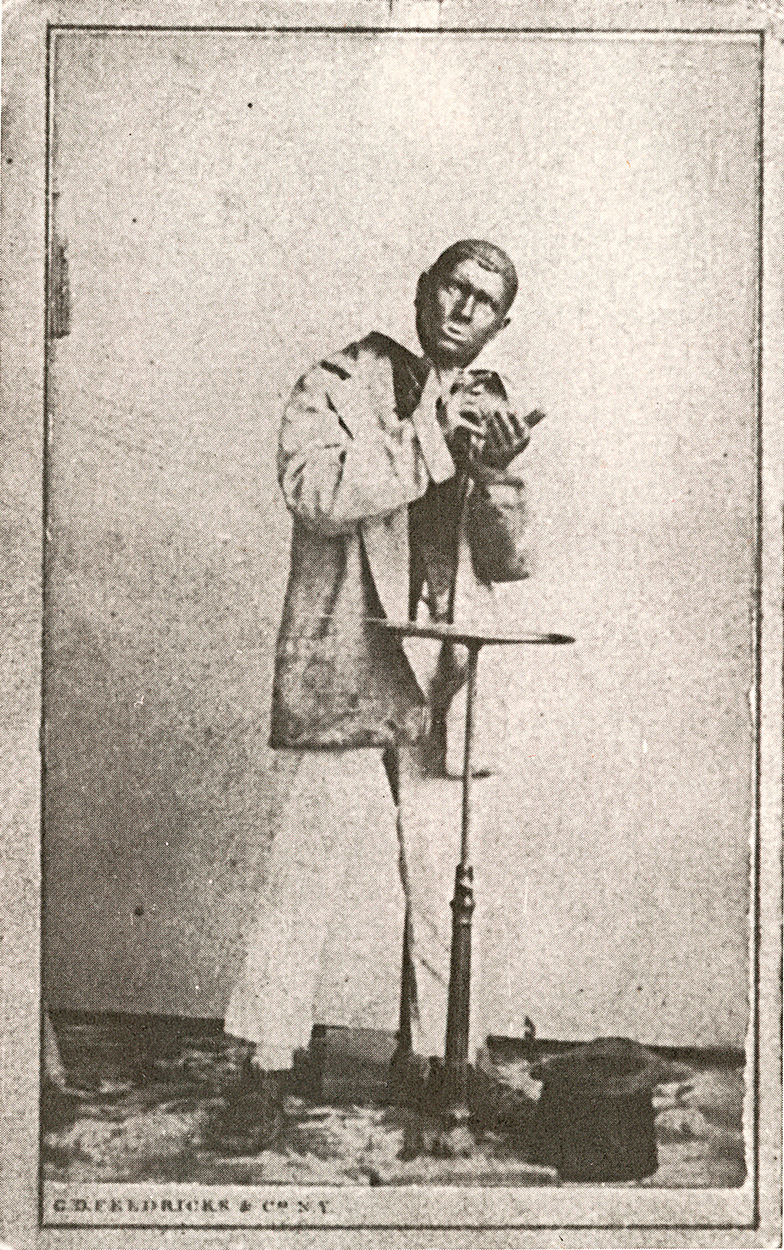
The song was first composed in 1853 by the blackface minstrel Dan Emmett. Daniel Decatur Emmett was one of the 'pioneers', so to speak, of the minstrel tradition, founding the first all-blackface troupe and beginning the minstrel show as a main event rather than a part of a larger performance. Dan Emmett is also known for writing the song "Dixie", which became a Confederate anthem.
Dan Emmett in blackface
The blackface tradition marks an ugly time in American folk music history, when crudely caricatured stereotypes of African-Americans were used for comedic entertainment. The character rose to prominence in a theatrical climate where stereotyped, over-the-top stock characters representing various ethnicities and social classes was the norm. The representation of the 'Jim Crow' blackface character was as a buffoonish, lazy, superstitious, cowardly, and lascivious character. Black people were often portrayed as pathological criminals and thieves. Lines were typically delivered in heavily mangled imitations of the black vernacular.
The portrayal of black women, typically by white men who were both wearing blackface and cross-dressing, presented black women as either grotesquely unattractive or, conversely, highly sexualized.
The blackface tradition deserves careful and critical examination of its full role as a force of cultural appropriation, mockery, and dissemination, including its development and continuing impacts. Unfortunately, this blog is not the proper forum for such a necessarily sensitive and in-depth investigation at this time, as our purpose in this post is to explore the individual song and its derivatives. Therefore, for the time being, I encourage readers interested in the history of blackface to seek out existing works that treat on the issue, and remind all readers that blackface is considered very hurtful and highly offensive. This blog does not endorse or encourage the use of blackface, and cautions anybody from attempting it in any circumstances.
It is worth noting that although Jordan is a Hard Road to Travel is indeed a song originated in blackface minstrely, it has since entered into the collection of general folk songs, and in its modern rendition does not generally carry the racist connotations, intent, and mockery that typify the blackface tradition. Rather than being a mimicking song meant to evoke stereotypes of a clownish black person, it is now sung earnestly and unironically by bluegrass and folk musicians. Indeed, the original lyrics of Dan Emmett's version (which, by all accounts, was a modular and ever-changing collection of verses) are largely forgotten, being replaced for most musicians by the lyrics written by Uncle Dave Macon. Macon, who recorded the song in 1927, used words that had an anti-automobile message- perhaps influenced by Macon's former employment as a horse-and-buggy driver and goods hauler.
For Uncle David Macon's lyrics, see the following arrangement by Norman and Nancy Blake.
1. I'm gonna sing you a brand new song,
It's all the truth for certain;
We cain't live high, but we can get by,
And get on the other side of Jordan.
Chorus: Oh, pull off your overcoat and roll up your sleeves,
Jordan's a hard road to travel;
Oh, pull off your overcoat and roll up your sleeves,
Oh, Jordan is a hard road to travel, I believe.
2. The public schools and the highways
Are raisin' quite an alarm;
Get a country man educated just a little,
And he ain't a-gonna work on the farm.
3. I don't know, but I b'lieve I'm right,
The auto's ruined the country;
Let's go back to the horse and buggy,
And try to save some money.
4. I know a man that's an evangelist,
His tabernacle's always full;
People come from miles around
Just to hear him shoot the bull.
5. You may talk about your evangelist,
You may talk about Mister Ford too;
Well, Henry's shakin' more hell out of folks Than all the evangelists
do.
6. Rain forty nights, gonna rain forty days,
Gonna rain on the Allegheny mountains;
Gonna rain forty horses and dominicker mules,
Gonna take us on the other side of Jordan.
The original lyrics, as mentioned earlier, were variable. An example of an early, minstrel show version of the song might go something like this:
Around the Crystal Palace there are a great many shows, Where all the country green horns are drawn in-- There're snakes and alligators, mammouth mules and big 'taters, That were raised upon the other side of Jordan.
Chorus:
Pull up your overcoat and roll up your sleeve
Jordan am a hard road to travel
pull off your overcoat and roll up your sleeve
Jordan am a hard road to travel I believe
The sovereign of the seas, she went to Liverpool, In less than fourteen days, too, according, Johnny Bull he wiped his eyes, and looked with surprise, At this clipper from the Yankee side of Jordan.
The ladies of England have sent a big address About slavery, and all its horrors, according, They had better look at home, to their own white slaves, That are starving on the English side of Jordan.
They have got o bearded lady down at Barnum's show, And lots of pictures outside, according, She's going to take her eye-lashes for a pair of mustaches, For to trabble on the other side of Jordan.
The Duchess of Southerland, she keeps the Stafford House, The place where the "Black Swan" is boarding; At a musical party, they asked for a song, And she gave them--On the other side of Jordan.
Our great father, Washington, he was a mighty man, And all the Yankees do their fighting according, They will raise the flag of freedom whereever they can, Till they plant it on the other side of Jordan.
There are two derivatives that bear mentioning off of Jordan Is A Hard Road to Travel- the first is a New York ballad called the "Dead Rabbit Song", and the second is a Union army marching song called "Richmond Is a Hard Road to Travel"
Dead Rabbits in Scorcese's film, "Gangs of New York"
Readers might recognize the name "Dead Rabbits" from Martin Scorcese's film, The Gangs of New York. While the film did have some historical inaccuracies as is to be expected of Hollywood, it is true that the Dead Rabbits were a largely Irish-American gang in the Five Points area of New York. The Dead Rabbit uniform was a red stripe on the leg of their pants, a
counterpoint to the Roach Guard blue stripe. When engaged in riots and
street fights, their emblem was a slain rabbit impaled on a spike. The name may have come from the Gaelic "Raibead", meaning 'great, hulking person', appended with 'Dead', slang for 'very'- thus, the Dead Rabbits were "very big people". Its leaders included such figure as Aidan Bourke, 'The Black Dog', perhaps named after the mythological black dogs and Cu-Sidhe hounds of the British Isle, thought to be portents of death.
Also called the Black Birds, the Dead Rabbits were originally part of the Roach Guards, an Irish Five Points gang started in the early 19th century to protect liquor merchants. The Dead Rabbits broke off of the Roach Guards, and the two gangs swore a bitter rivalry against each other, engaging in near-constant fighting over the Five Points. Elsewhere, however, they united with the Roach Guards and other Irish gangs such as the Shirt Tails and Chichesters to fight the Bowery Boys.
The Bowery Boys were a nativist, anti-Irish, and anti-Catholic gang . Their base of operations, as their name implies, was the Bowery north of the Five Points. As depicted in Scorcese's film, the Bowery Boys frequently dressed in dressed in black stovepipe hats, red shirts, black flared trousers, high-heeled calfskin boots and black vests, with oil-slicked hair.
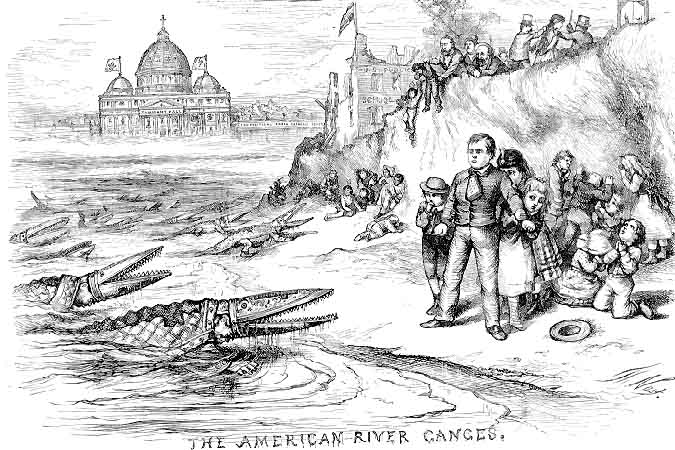
Anti-Catholic cartoon from the 1800s. Note the Bishop-gators.
The Bowery Boys were a nativist, anti-Irish, and anti-Catholic gang .
Their base of operations, as their name implies, was the Bowery north of
the Five Points. As depicted in Scorcese's film, the Bowery Boys
frequently dressed in dressed in black stovepipe hats, red shirts, black
flared trousers, high-heeled calfskin boots and black vests, with
oil-slicked hair. Famous members of the Bowery Boys included William "Bill the Butcher" Poole (sometimes referred to instead as the leader of the Atlantic Guards, an allied gang), and the gang's leader, Mose the Fireboy.
The gang and ethnic rivalry was closely tied to the rivalry within the Democratic Party political machine that operated in New York City. This rivalry pitted supporters of Tammany Hall and Mayor Fernando Wood against those in opposition to his administration. The Dead Rabbits were aligned with Wood, while the Bowery Boys opposed him and allied themselves with the Democratic opposition, the nativist Know-Nothing Party (or "American Party"), and with state Republicans who sought to strip Wood of certain powers by handing jurisdiction to a number of issues over to the state. These plans included the replacement of the Municipal Police Department with a state-managed Metropolitan Police Department. While legislation was passed that created the Metropolitan Police, Wood refused to disband the Municipal Police. The first half of 1857, therefor, saw running street battles between the two departments and each side's supporting gangs despite a court order that the city disband the Municipal police by July.
On July 4th, this conflict came to a head at the Dead Rabbits Riot. The Dead Rabbits had planned to raid a Bowery Boys clubhouse that day, and marched towards the place with a coalition of Five Points street gangs. The Bowery gangs met this assault at the clubhouse. Heavy fighting ensued, and the Bowery gangs eventually drove the Five Point gangs back to Paradise Square after heavy street fighting, with conflicts in Pearl, Chatham Streets, and the north part of Park Row.
The Dead Rabbits Riot
The next day, the Dead Rabbits struck again, attacking the Green Dragon on Broome Street, a Bowery Boys joint. Catching the Bowery Boys by surprise, the Rabbits wrecked the bar, tore up the dance floor, and drank or absconded with all the alcohol. The incensed Bowery Boys called on the other Bowery gangs to repel the Five Pointers, and heavy fighting ensued at Bayard Street, quickly growing to become the largest gang battle in the city's history. An attempt by a Metropolian police officer to arrest the leaders of the fight was met with the officer being stripped and beaten by the gangs. This officer returned to the precinct to request aid. Around mid-day, a squad of Metropolitan police to make arrests. Their presence, however, briefly united the gangs, who climbed into the roof tops and rained bricks down on the police to secure the release of captured gang members. The police retreated, prompting a short truce between the gangs.
This truce was broken mere hours later, when a group of Dead Rabbits, prompted by Five Points women, attacked the Bowery gangs at The Tombs. The renewed fighting so occupied the police force, that other gangs and criminals took advantage of the chaos to commit crimes and carry on fights elsewhere in the city. This grew the fight, which involved some 800-1000 gang members, into a larger riot involving hundreds of others who opportunistically looted the Bowery.
By the afternoon, the Metropolitan police came back in greater force. This time, they were able to briefly clear the streets, arresting large numbers of men including some gang leaders. At about this time, a degree of collusion began between the Bowery Boys and Metropolitans, both focusing on the Dead Rabbits. The police surge briefly quieted the streets, but fighting resumed almost immediately, and further attempts by the police to penetrate the riot proved unsuccessful. By the evening, the underworld-connected political boss of the Sixth Ward, Isaiah Ryders, was called in by the police to address the crowd and ask them to stop fighting. This effort failed, as Ryders was driven away by stones and bricks. At this point, with fires burning in the city and no end in sight to the violence, the police made the decision to call in the military. By 9:00 pm, two local regiments of the New York National Guard accompanied by 150 Metropolitan police swept through the riot area. This show of force managed to quell the riot, and police and guardsmen patrolled the area heavily for the next day.
This was the largest New York riot since the Astor Place Riot in 1849 and would be unsurpassed until the Draft Riots of 1863- all three of these incidents largely involving working class Irish-American immigrants and stemming from issues of class, ethnicity, and policy. The two day Dead Rabbits Riot left at least eight men dead and some 30-100 injured. The real casualty count may be higher, as many of those killed are believed to have been carried off to secret burial by their gang-mates.
The Dead Rabbits Song was a ballad recounting the riot. The song was written by Henry Seamus Backus, known as the Saugerties Bard. Backus was a former Saugerties music teacher who had turned to heavy drinking after the deaths of his daughter, mother, and wife. He had spent time in an insane asylum, mad with liquor and religion, for part of the late 1840s before returning to Saugerties to write store jingles and popular songs. An eccentric figure, Backus reportedly traveled in a broken-down wagon decked in bells and American flags, often accompanied by a grand procession of barking dogs. He would travel from town to town, playing popular tunes, singing his new lyrics, and selling broadsides.
Chorus Then pull off the coat and roll up the sleeve, For Bayard is a hard street to travel; So pull off the coat and roll up the sleeve, The Bloody Sixth is a hard ward to travel I believe.
Like wild dogs they did fight, this Fourth of July night, Of course they laid their plans accordin'; Some were wounded and some killed, and lots of blood spill'd, In the fight on the other side of Jordan.
Chorus The new Police did join the Bowery boys in line, With orders strict and right accordin; Bullets, clubs and bricks did fly, and many groan and die, Hard road to travel over Jordan.
Chorus When the new police did interfere, this made the Rabbits sneer, And very much enraged them accordin'; With bricks they did go in, determined for to win, And drive them on the other side of Jordan.
Chorus Upon the following day they had another fray, The Black Birds and Dead Rabbits accordin; The soldiers were call'd out, to quell the mighty riot, And drove them on the other side of Jordan.
Another variation of Jordan is a Hard Road to Travel worth noting is "Richmond Is a Hard Road to Travel", a version composed by Union soldiers fighting in Virginia during the first two years of the Civil War. The song recounts the difficulties the army had in its attempts to capture the Confederate capitol at Richmond. The song can be found here, arranged here by the 2nd South Carolina String Band.
The song unusually long, telling in essence the whole course of early part of the war.
Would you like to hear my song? I'm afraid it's rather long
Of the famous "On to Richmond" double trouble,
Of the half-a-dozen trips and half-a-dozen slips
And the very latest bursting of the bubble.
'Tis pretty hard to sing and like a round, round ring
'Tis a dreadful knotty puzzle to unravel;
Though all the papers swore, when we touched Virginia's shore
That Richmond was a hard road to travel.
Then pull off your coat and roll up your sleeve,
Richmond is a hard road to travel
Then pull off your coat and roll up your sleeve
Richmond is a hard road to travel, I believe.
First, McDowell, bold and gay, set forth the shortest way,
By Manassas in the pleasant summer weather,
But unfortunately ran on a Stonewall, foolish man,
And had a "rocky journey" altogether;
And he found it rather hard to ride o'er Beauregard,
Today's song is Jack Hall, an 18th-century English ballad about a bitterly unrepentant criminal collected in the Roud Folk Song Index. The song, also known is Sam Hall, is based on a real-life figure. Jack Hall was sold as a climbing boy to a chimney sweep for a single guinea. The unfortunate youth became an infamous thief and highwayman. He was arrested in 1707, along with Stephen Bunce and Dick Low for the burglary of the house of Captain Guyon near Stephney. All three were convicted and hanged at Tyburn on December 7th, 1707. The song was known as Jack Hall primarily up until the 1850s, when the English comic minstrel CW Ross popularized the song as Sam Hall. The song has been locally adapted in Ireland and the United States. Folk music historians have noted similarities between this piece and the song Captain Kidd.
The following video shows the Dubliners with their rendition of Sam Hall, which adapts the song to Ireland by changing the place of the hanging to Cootehill, in County Cavan.
Steeleye Span has recorded a folk-rock version of the song under the original name Jack Hall, found here.
The song's lyrics are as follows. Note that in the original, the name was "Jack Hall", and the hanging place was Tyburn Hill, rather than Cootehill.
Oh my name it is Sam Hall chimney sweep, chimney sweep
Oh my name it is Sam Hall chimney sweep
Oh my name it is Sam Hall and I've robbed both great and small
And my neck will pay for all when I die, when I die
And my neck will pay for all when I die
I have twenty pounds in store, that's not all, that's not all
I have twenty pounds in store, that's not all
I have twenty pounds in store and I'll rob for twenty more
For the rich must help the poor, so must I, so must I
For the rich must help the poor, so must I
Oh they took me to Cootehill in a cart, in a cart
Oh they took me to Cootehill in a cart
Oh they took me to Cootehill where I stopped to make my will
Saying the best of friends must part, so must I, so must I
Saying the best of friends must part, so must I
Up the ladder I did grope, that's no joke, that's no joke
Up the ladder I did grope, that's no joke
Up the ladder I did grope and the hangman pulled the rope
And ne'er a word I spoke, tumbling down, tumbling down
And ne'er a word I spoke tumbling down
Oh my name it is Sam Hall chimney sweep, chimney sweep
Oh my name it is Sam Hall chimney sweep
Oh my name it is Sam Hall and I've robbed both great and small
And my neck will pay for all when I die, when I die
And my neck will pay for all when I die
Tyburn hill, where the real Jack Hall was hanged, is a small village now engulfed in present-day London, named for the Tyburn stream, which is now paved over. The village was the central site of capital punishment in England for centuries, being the place where the Crown executed many criminals, traitors, and religious dissidents up until 1783.
Executions began there as early as 1196, when populist leader William 'the Bearded' Fitz Osborn was hanged there. William Osborn was a fiery preacher who roused the poor of London in a movement against the city's rich, gathering weapons throughout the city and amassing a large following. The Archbishop of Canterbury, Hubert Walter, fearing an insurrection, sent men to arrest William. The preacher fled into the nearby church of Saint Mary le Bow, attempting to use it not as a sanctuary, but as a fortress. The church was a poor choice, as most of William's followers refused to defend it by force, and the building was set on fire by the Archbishop's men, who wounded William in the stomach as he emerged from the burning structure. William was convicted, dragged naked by horse to Tyburn, and hanged.
A hanging at the Tyburn Tree
Tyburn continued to be used as an execution site for the better part of the millennium. The leaders of the Catholic/Populist Pilgrimage of Grace uprising were hanged there in 1537, among many other Catholic martyrs over the years. Also notable was the hanging of Oliver Cromwell, John Bradshaw, and Henry Ireton, who
were dug up from the grave and hanged as
punishment for their roles in beheading King Charles I. By 1571, the site was so frequently used that a special gibbet known as the Tyburn Tree was built there to enable mass executions (in some cases, as many as twenty-four people hanged simultaneously). The Tyburn Tree stood in the middle of the road way, providing a landmark on the way to London, a warning to criminals, and a steady source of cadavers for anatomists. Executions at Tyburn proved a public spectacle, bringing crowds numbering in the thousands. Such a spectacle would have been the last sight of the historic Jack Hall.
The song has been adapted in American form. In this version, Sam Hall is no longer a burglar, but a convicted murderer. The song comes across as less wistful than the English version, and more spiteful. There is no mention of 'the rich must help the poor' or any other attempt to endear Sam Hall as a Robin Hood like figure or social bandit. Any endearment that the Sam Hall in the American version gets comes only from his abrasive, defiant attitude to death. The song can be found here, arranged by Johnny Cash.
The lyrics to this version are as follows. Note that in some versions, the singer says, "damn your hide", instead of "damn your eyes". Other variations include replacing "and I hate you one and all" with "and you're a bunch of fuckers all" or other insults.
Well, my name it is Sam Hall, Sam Hall.
Yes, my name it is Sam Hall; it is Sam Hall.
My name it is Sam Hall an' I hate you, one and all.
An' I hate you, one and all:
Damn your eyes.
I killed a man, they said; so they said.
I killed a man, they said; so they said.
I killed a man, they said an' I smashed in his head.
An' I left him layin' dead,
Damn his eyes.
But a-swingin', I must go; I must go.
A-swingin', I must go; I must go.
A-swingin', I must go while you critters down below,
Yell up: "Sam, I told you so."
Well, damn your eyes!
I saw Molly in the crowd; in the crowd.
I saw Molly in the crowd; in the crowd.
I saw Molly in the crowd an' I hollered, right out loud:
"Hey there Molly, ain't you proud?
"Damn your eyes."
Then the Sherriff, he came to; he came to.
Ah, yeah, the Sherriff, he came to; he came to.
The Sherriff, he come to an he said: "Sam, how are you?"
An I said: "Well, Sherriff, how are you,
"Damn your eyes."
My name is Samuel, Samuel.
My name is Samuel, Samuel.
My name is Samuel, an' I'll see you all in hell.
An' I'll see you all in hell,
Damn your eyes.
The song is also known in the US Air Force as the hilariously uncouth marching song "Sammy Small". Lyrics and a beautifully rendered recording can be found here. In addition to this rendition, there is a Vietnam War version of Sammy Small which has decidedly anti-war lyrics.
Today's song is Down by the Sally Gardens, an adaptation of a poem by WB Yeats, not to be confused with the reel titled "Sally Gardens". The word 'salley' is lesser known English variation of the word
'sallow', meaning 'willow'. It is similar to the Irish word 'saileach',
Old English 'sealh' and the Latin 'salix', all also meaning 'willow'.
I have chosen the gorgeous arrangement sung by Maura O'Connell with Karen Matheson, seen on the BBC/RTE co-production, TransAtlantic Sessions.
The lyrics, as written by WB Yeats, are as as follows:
Down by the salley gardens my love and I did meet;
She passed the salley gardens with little snow-white feet.
She bid me take love easy, as the leaves grow on the tree;
But I, being young and foolish, with her would not agree.
In a field by the river my love and I did stand,
And on my leaning shoulder she laid her snow-white hand.
She bid me take life easy, as the grass grows on the weirs;
But I was young and foolish, and now am full of tears.
The poem was originally published in 'The Wandering of Oisin and Other Poems' as 'An Old Sung Resung' According to Yeats, it was "an attempt to reconstruct an old song from three lines imperfectly remembered by an old peasant woman in the village of Ballisodare, Sligo, who often sings them to herself." The identity of this song is uncertain, but it is likely to have been "The Rambling Boys of Pleasure". This song can be found here, arranged by Andy Irvine.
The lyrics of the song are as follows:
You rambling boys of pleasure, give ear to those few lines I write,
Although I'm a rover, and in roving I take great delight.
I set my mind on a handsome girl who ofttimes did me slight,
But my mind was never easy till my darling were in my sight.
It was down by Sally's Garden one evening late I took my way.
'Twas there I spied this pretty little girl, and those words to me sure she did say
She advised me to take love easy, as the leaves grew on the tree.
But I was young and foolish, with my darling could not agree.
The very next time I met my love, sure I thought her heart was mine,
But as the weather changes, my true love she changed her mind.
Cursed gold is the root of evil, oh it shines with a glittering hue,
Causes many the lad and lass to part, let their hearts be ever so true.
Sure I wish I was in Dublin town, and my true love along with me.
With money to support us and keep us in good company.
With lots of liquor plentiful, flowing bowls on every side,
Let fortune never daunt you, my love, we're both young and the world is wide.
But there's one thing more that grieves me sore is to be called a runaway
And to leave the spot I was born in, oh Cupid cannot set me free,
And to leave that darling girl I love, oh alas, what will I do?
Will I become a rover, sleep with the girl I never knew
Yeat's words, based off of You Rambling Boys of Pleasure, were never set to that song's tune. Instead, they have been adapted to various different melodies. These include the Moorlough Shore (also the tune of "The Foggy Dew") in 1909 by Herbert Hughes, an original piece by Rebecca Clarke in the 1920s, a piece by John Ireland in 1934, a vocal setting by Ivor Gurney in 1938, and a setting by Benjamin Britten in 1943. The version by Britten, based on an earlier Irish tune, is the most widely used one in folk music circles today, and the one that Maura O'Connell sings above.
Also, of interest is an American song with a similar tune and name, called "Down in a Willow Garden", also known as "Rose Connelly". It can be found on this video, performed by the Kossoy Sisters.
Interestingly, this version of the song radically departs from takes the form of a murder ballad, with the following lyrics
Down in the willow garden
Where me and my love did meet
there we sat a-courtin'
My love dropped off to sleep
I had a bottle of Burgunday wine
which my true love did not know
and there I poisoned that dear little girl
down under the banks below
I stabbed her with my dagger
which was a bloody knife
I threw her into the river
which was a dreadful sight
my father often told me
that money would set me free
if I would murder that dear little girl
whose name was Rose Connelly
and now he sits by his old cottage door
wiping his tear-dimmed eyes
and now he waits for his own dear son
upon the scaffold high
my race is run beneath the sun
though Hell's now waiting for me
for I did murder that dear little girl
whose name was Rose Connelly
This song likely originated in Ireland before coming to America. A song called "Rose Connelly" is mentioned by folk music collector Edward Bunting in Coleraine near Derry in 1811, and a version of the song was documented in Galway in 1923. In America, the song was originally restricted to Appalachia, leading later folk music historian DK Wigley to conjecture that "It is as if an Irish local song never popularized on broadsides was spread by a single Irish peddler on his travels through Appalachia." The song was first documented in America in 1895 in Wetzel County, West Virginia. Cecil Sharpe documented the song's existence in North Carolina and Virginia in 1918. Though a wide variety of verses have historically existed, the song has become solidified to a standard several verses through recording and popularization. The first professional recording was done in 1927 by GB Grayson and , and the song became more widely known following Charlie Monroe's recording in 1947.
It is likely that the lyrics of "Down by the Willow Gardens" are related to the Irish song Wexford Girl, also known as Oxford Girl or The Bloody Miller, which also gave rise to the American song Knoxville Girl. Wexford Girl is itself likely derived from the old English song, The Cruel Miller. It has been noted that part of the melody is only similar to Down in Sally Gardens, but is also the melody to Rosin the Beau. These several songs, however, will be the subjects of a future posts.