Showing posts with label scottish folk. Show all posts

Saturday, October 26, 2013

Daemon Lover/House Carpenter

Hello, reader(s)! Because the blog missed two weekdays, I thought I'd start to make them up with some extra posts. So, today's folk infusion is "The Deamon Lover", a Scottish folk song known in America as "The House Carpenter" (Roud 14, Child 243). The song is also sometimes called "James Harris" or "James Harries".

The song tells the story of a woman whose former lover has come to visit her after being long away at sea. The woman tells this lover that she will not go with him him or marry him, because she now has a husband and children. In some versions, the husband is named as James Harris or his occupation is given as a house carpenter. The lover convinces her to come with him by promising her ships, wealth, and travel. The woman goes along with him, only to fall into mourning as she misses her husband and babe and discovers that her lover was not her lover at all, but the devil come to trick her into damnation. The devil shows her the hills of heaven and the hills of hell, and tells her she is going to hell, then sinks the boat, killing her.

Here is The Deamon Lover performed by Alasdair Roberts.


The lyrics, as arranged in Alasdair Roberts' rendition, are as follows:

Where have you been my long, long love
These seven long years or more?
I'm seeking for my former vows
You gave to me before'

'Oh, hold your tongue of your former vows
For they will breed sad strife
Hold your tongue of your former vows
For I'm become a wife'

He's turned him right and round about
And the salt tear blint his ee
'I never would have trodden on Irish ground
But for the love of thee'

'If I should leave my dear husband
And my two babes also
What have you to take me to
If I with you would go?'

'I've seven ships upon the sea
And the eighth brought me to land
With four and twenty mariners bold
And music on command'

She's put her foot on board the ship
No mariners she beheld
But the sails were of the taffeta
And the masts of the beaten gold

They had not sailed a league, a league
A league but barely three
Til dismal grew his countenance
And drumly grew the sea

They had not sailed a league, a league
A league but barely three
Until she saw his cloven foot
And she wept most bitterly

'Leave off your weeping' then said he
'Of your weeping let me be
And I'll show you how the lilies grow
On the banks of Italy'

'What hill, what hill is thon I see
As white as any snow?'
'Thon is the hill of heaven' he said
Where all good people go

'What hill, what hill is thon I see
As black as any coal?'
'Thon is the hill of hell' he said
'Where you and I must go'

He struck the top mast with his hand
And the main mast with his knee
And he struck that gallant ship in two
And he sunk her beneath the sea.

Here is the more lively American adaptation, House Carpenter, performed by American folk master Doc Watson.


Here is another arrangement of House Carpenter, performed in an even more lively rendition by the Irish band Sweeney's Men.


Also worth noting is Bob Dylan's song, the Man in the Long Black Coat, which tells the story from the House Carpenter's perspective. Because Bob Dylan does generally not allow his own recordings to be shared freely on the internet, here is that song covered by Mark Lanegan:

Friday, October 18, 2013

John Barleycorn

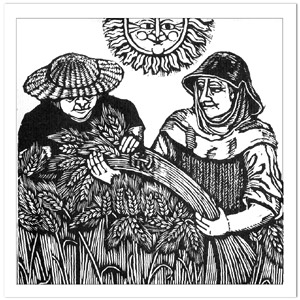
Welcome back to Folk Infusion! Today's a Friday- across the city and in towns all over the world, they're rolling out the kegs and hauling up the bottles for the kick-off to the weekend. In that spirit, today's post is a great personal favorite of mine suited for the occasion. John Barleycorn is a traditional English ballad in which barley is personified and murdered to create alcohol- either beer or whiskey, depending on the interpretation. In the song, the various stages of barley cultivation, harvesting, and processing are represented as acts of violence on the personified grain.

Printed renditions can be found as far back as the 16th century, and various versions can be found across the British Isles, from 17th-century English broadsides to Robert Burns' 1782 edition. The themes of the song bear similarity to Quhy Sowld Nicht Alane Honorit Be (Why Should Allane Not Be Honored), a 15-16th century Scots poem which personifies ale in a like manner.

It is likely that the family of related barley-personifying songs trace their origin back to Scotland prior to the mid-16th century, with the song Alan-a-Maut. The name John Barleycorn for this personification was first noted in the 1624 London broadside "A Pleasant new Ballad.  To be sung evening and morn, of the bloody murder of Sir John Barleycorn", which also sets forth some of the elements of John Barleycorn- men (or knights) swearing to slay him, rain and sun, his beard, and the milling. Other broadsides appeared after this called The Little Barleycorne and Mas Mault, though these were more concerned with alcohol's effects than its manufacturing. The first versions of what is now known as John Barleycorn can be traced to three versions collected in Great Britain between 1750 and 1775, two from Scotland and one from the London area. A diversity of broadsides and versions have emerged since then, mostly following two basic strains.

In addition the obligatory link to my own rendition, I have chosen the 1970 arrangement of the song by Traffic.


The following arrangement of this version is sung more as a chant.


The lyrics of this version are as follows:

There were three men came out of the West
Their fortunes for to try
And these three men made a solemn vow
John Barleycorn must die
They've ploughed, they've sewn, they've harrowed him in
Threw clouds upon his head
And these three men made a solemn vow
John Barleycorn was dead

They've let him lie for a very long time
Till the rains from heaven did fall
And little Sir John sprung up his head
And so amazed them all
They've let him stand till midsummer's day
Till he looked both pale and wan
And little Sir John's grown a long, long beard
And so become a man

They've hired men with the scythes so sharp
To cut him off at the knee
They've rolled him and tied him by the way
Serving him most barbarously
They've hired men with the sharp pitchforks
Who pricked him to the heart
And the loader he has served him worse than that
For he's bound him to the cart

They've wheeled him around and around the field
Till they came unto a barn
And there they made a solemn oath
On poor John Barleycorn
They've hired men with the crab-tree sticks
To cut him skin from bone
And the miller he has served him worse than that
For he's ground him between two stones

And little Sir John and the nut-brown bowl
And he's brandy in the glass
And little Sir John and the nut-brown bowl
Proved the strongest man at last
The huntsman, he can't hunt the fox
Nor so loudly to blow his horn
And the tinker he can't mend kettle nor pot
Without a little Barleycorn


The second strain worth noting is an Irish version which is rarer, faster tempo, and lyrically related more closely to "A Pleasant Ballad", containing the line, "Some of them said drown him and the others said hang him high, for whoever sticks to the barley grain, a beggin he will die", which survived in no other versions.


The lyrics of this version are as follows:

There were three farmers in the north, as they were passing by
they swore an oath so mighty oh that Barleycorn should die
one of them said: drown him and the other sad: hang him high
for whoever will stick to Barleycorn a-begging he will die

They put poor Barley into a sack an a cold an rainy day
and took him out to cornfields and buried him in the clay
frost and snow began to melt and dew began to fall
when Barleygrain put up his head and he soon surprised them all

Being in the summer season and the harvest coming on
it's the time he stands up in the field with a beard like any man
the farmer came with his pitch fork and he pierced me to the heart
like a thief, a rogue or a highwayman they tied me to the cart

And next thing that they've done to me they dried me in a kiln
they used me ten times worse, than that they ground me in the mill
they used me in the kichen, they used me in the hall
oh they used me in the parlour among the ladies all

Ahe Barleygrain is a comical grain, it makes men sigh and moan
for when they drink a glass or two they forget their wives and home
the drunkard is a dirty man, he used me worst of all
he drank me up in his dirty mouth and he piss me 'gainst the wall

There were three farmers in the North and as they were passing by
They swore an oath, a mighty oath that John Barleycorn must die
One of them says we'll drown him and the other says hang him high
A whiff of the stick of the barley grain and a-beggin we will die
With me fal-er-a-lind-a-me too-ra-lunda-me whack-fal-diddle-di-ay


That's the week! Skål!